Extension Out of the Pocket
Free to watch. No account needed.
22 more lessons in Throw come with membership.
7 days free, then $9.99 a month or $99.99 a year on the web. Cancel any time.
Transcript
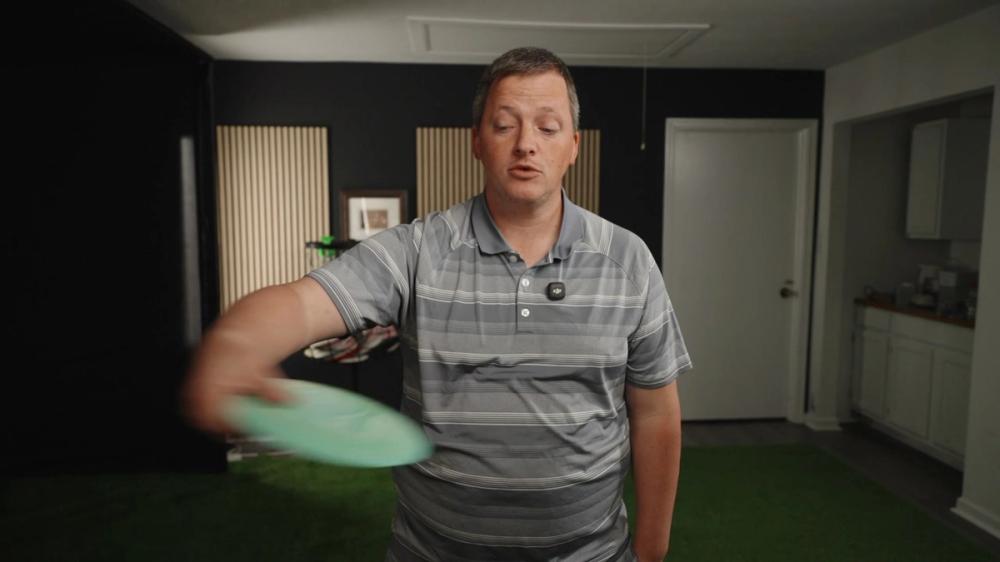
First thing we're going to do is we're going to build the pocket. Now some of you have already done this from the coil module, but we're going to hit it again. Okay, so what I want you to do is I want you to take the disc, put it in the middle of your chest here, maybe favor your front side a little bit, not on your back shoulder here, and I want you to wrap your hand around the disc like this. So you're going to get this set up here where you've got arm, disc, body.
This is the pocket. Okay, you'll also notice that my hand is on what I would call if I'm throwing at 12 o'clock, my hand is wrapped around like eight as a right-handed player. If you were a lefty and you were throwing that way as your 12 o'clock, you'd be wrapped around about four or five. So curl around like that, not like this.
Okay, and this is really crucial to the extension because if your hand's up front like this, now you're going to have disc in hand and your elbow is going to be tight up against your body. And when you do that, if you go to extend and keep your elbow in place, this is what that feels like. You'll remember, right? And then we have here, huge lever, right?
It just feels massive when you do this instead of this. Again, your checkpoints are that you've got the disc towards the center of your chest here. You've got arm, disc, chest, and then you've got your hand wrapped around the back. Now, it doesn't have to be here, right?
We're not doing this and collapsing our pocket here. We're there, right? So not truly on the back of the disc. So if you've got that, you have built a good pocket.
Let's go into the extension. The extension, I'm talking about this move right here. So we're in our pocket. The elbow has done its job.
It is done moving at this point and the hand goes. So you could feel it by keeping your elbow in place and just opening here. Okay, if you have a hard time doing that and you're going like this and the elbow is just continuing to move, that's not an extension, right? Your extension is going to be really behind you at that point.
Ask me how I know, right? So here we want the elbow to stay. You can facilitate this by keeping your hand on your elbow and feeling that. Now, in order to feel that, thankfully, there's something that a lot of us have done that has the same motion in it.
And it's your typical towel pop. Okay, so there are some things that are very different about a towel pop, but what is very similar is that you're not popping like this and your elbow is not continuing to go here. There's a point where if you're whipping this sucker that your elbow is going to stop. Okay, so I want you to roll this thing up and I want you to pop.
If you cannot pop a towel, I guarantee you, you are not going to get the extension right. So those of you who are there who are like doing this and the elbow is still moving. Pop a towel. It's so low effort and high reward for what you put into just popping a towel and what you get out of it feel wise that I think you're insane if you don't just figure out how to do this.
So do what you got to do. Get in this kind of towel pop mindset and just pop the towel first. Okay, get a nice towel pop and then we're going to back into it. The issue that a lot of people have when I give them a towel is they start thinking about disc golf, but the problem with disc golf is that your form screwed up.
So you start bringing disc golf into the towel pop and so you start going, here's what I do in my disc golf throw. And you have a crappy towel pop and a crappy disc golf throw. So forget about disc golf, pop the towel, bring the towel pop into just this final part of the disc golf move. That's all I'm asking.
So here, if I were whipping a towel, I do this and I get people to actually curl this sucker when we're working together. It's like you don't curl this thing before you pop it. You just leave it floofy like this, curl it and pop. I don't care if there are little pumps in here or whatever you got to do to make the towel pop.
But if it does not pop, you cannot pass this part of the module. You just can't do it. Once you have a towel pop, then you go in and you grab the feel. And the feel is, okay, when I pop this towel, okay, this is what he's talking about.
The elbow is staying still. Try it the wrong way. After you have a successful towel pop, go back and say, okay, if I keep moving my elbow and I keep going, the thing doesn't pop. So I need, it's kind of tight.
This is almost a unit up here at this point where it's just this extension here. Watch out, watch out, watch out, watch out, watch out, watch out, watch out, watch out. Okay. So that's the extension.
And the whole point of getting in the pocket is so that we can pop the towel or pop the disc. No pocket. We can, you can pop. Not nearly as good as long lever.
We want nice long towel whip, good pop out of there. So that requires a very still elbow at this point. Now that I've got that, I can go to my disc here. I'm going to grip, uh, with a little front loaded light grip.
So I don't put this thing through my wall when I try this, but I'm gonna keep my grip very loose, but I want to feel this same little pop here. Okay. Don't go too hard on this. You will hurt yourself.
So I just want to feel pop, pop, pop, pop, pop, pop. Now, if you struggle when pulling it to a disc makes sense because we have a lot more control over a disc. It's a lot more firm than a towel is. So what I like for people to think about is when you pop a towel, when you aim a towel, you're probably thinking of the tip of the towel going where you want it.
For me, the tip of the towel is here, the backside of the disc. So if I think about it like that and I go, okay, I'm towel popping, watch out, watch out, watch out. And I've got a visual on where I'm popping this towel. If I go here, I can feel the back of that and you can hear it trying to move out of my hand in the tip of the towel, trying to whip around.
We want that. And again, be careful because this thing can come out of your grip. If you're not used to this swinging motion, if you're just coming through your hands on the front of it, usually there is no whip. So you kind of miss that normally, but my pinky keeps slipping off of this thing when I do this because it's trying to whip around.
Now, a real important technical point, if you're still struggling with this is about the wrist, just like with the towel. When you pop a towel, you don't go and flare your wrist open, right? You don't actively go and pop that wrist open. It's just slower.
If you do it that way, it's a bit weaker. So if you need to do it with the towel first to feel that, do that. Because if you go here and you're trying to pop your wrist open and flare your wrist open, you're not going to get that whip effect either. So this happens with the wrist back, I would say.
My order of preference would be that a curled wrist is better than an unfurled wrist. And then inside that, I would say if you can be loose and curled, that's better than tight and curled. But I would rather it be tight and curled than loose and open, if that makes sense. So I need this position.
If you can do it more loosely, I would take that. But you got to get in that position and keep that wrist back either way. All right, now I'm going to step back and I'm going to do this and actually throw. And not only am I going to step back, I'm going to step closer to my net because I don't want to have to think about how squirrely this is going to get.
Again, I'm going to go loose grip. So I just want to make sure it comes out because when we go this slow, it can definitely get squirrely. Okay, so here I just want to feel boom, boom, boom, boom. Got it.
That's all I'm feeling to that extension. Boom, boom, boom. And really important is I'm focusing on the tip of the towel. I'm not focusing just on locking out my arm.
It's I need this to pop. The arm will straighten out, but it's not going to lock out if you focus on the tip of the whip and not just extending your arm to extend your arm. So here feeling that I feel that it wants to come out of my grip and I just loosen up a little bit and I'm there. I can feel it moving around and I could feel it popping.
It's at this point that I want to talk about the follow through because one major difference with the towel pop and with the disc is there's no follow through on a towel pop, right? We pull our hand back and sometimes students ask me, am I actually pulling my hand back with the disc? No, you're not. So when you're working on this extension, it's robotic.
We're not bringing a bunch of speed in, which means that the body doesn't necessarily have any reason to want to follow through. Ideally, your follow through is your body just traveling on the same path. What it does is it lets your body know, hey, I've got this time after you do this very violent racing motion with your hand here. After the finish line here, I've got time to decelerate so that you can go fast here.
It's okay because I'm going to give you plenty of time to slow down. If you, after working on this or any point forward during the module, if you're hitting and you're abruptly stopping in this extension and there's no follow through, that's going to kind of wreck your arm a little bit. So we want to make sure that when we practice this extension, we go here and we go yeah, we practiced it like this to feel the backside going around. This is fine because this is not super violent.
But as we move forward, we want to make sure, okay, we go into that extension, pop and then follow through. And that follow through just happens on the same angle that this extension happens. So if you imagine if my elbow is kind of staying here, right, I go there, my hand just swung like this, it's going to continue swinging like that. So make sure that in your follow through, I would check your video, make sure that you're not going here and then going and tucking your arm down.
Sometimes that happens or sometimes people go here and then they go and they lift their arm up. It needs to just continue on that same path that you were working with on your extension, right? So if we're doing like an anhyzer, that would be here. My hand would follow that same path around or a roller, right?
I'd be here. Roller. My hand's not going to continue going up forever. It's going to go here.
It's going to kind of windshield wipe down on that direction. Big hyzer. The extension is going to happen here. Boom.
Nice, big follow through up on that same path. No dart in different directions. Let your body know, hey, we're safe here. We can hit this with some speed because we've got room to slow down on the backside.
Keep that in mind moving forward throughout this module. When you see me not follow through, it's because I'm not bringing that much speed into it. So I'm probably doing something that's more like here. Right?
With that amount of speed, my body's fine. It's not aggressive enough. But if I'm going fast, it's going to need some time to slow down on the back end. And that's the important thing about follow through is let your body go after that extension happens.
That's the extension. I often tell players that if I had to check one part of your throw to see what you did, I could get every piece of information that I needed from this. I could see how fast you're throwing. I can see what angle you're throwing on.
I could see what your nose angle is going to be coming out of there. I could see everything about your throw if I only saw your extension. I say that to warn you not to move on here from what I believe is the most important moment in the throw. So if you've got it, move on.
If you don't, don't. I'm going to give you a bonus drill after this for you to incorporate this feel into your pre-shot routine. We see this a lot from pros, but it's bonus. The core thing is that you understand this concept before you move on to the overtime module.